What is Bitcoin?
Bitcoin was created by Satoshi Nakamoto, a pseudonymous person or team who outlined the technology in
a 2008 white paper. It’s an appealingly simple concept: bitcoin is digital money that allows for
secure peer-to-peer transactions on the internet.
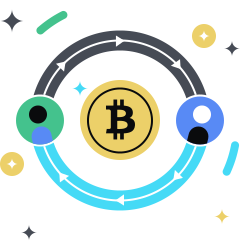
Unlike services like Venmo and PayPal, which rely on the traditional financial system for permission
to transfer money and on existing debit/credit accounts, bitcoin is decentralized: any two people,
anywhere in the world, can send bitcoin to each other without the involvement of a bank, government,
or other institution.
Every transaction involving Bitcoin is tracked on the blockchain, which is similar to a bank’s
ledger, or log of customers’ funds going in and out of the bank. In simple terms, it’s a record of
every transaction ever made using bitcoin.
Unlike a bank’s ledger, the Bitcoin blockchain is distributed across the entire network. No company,
country, or third party is in control of it; and anyone can become part of that network.
There will only ever be 21 million bitcoin. This is digital money that cannot be inflated or
manipulated in any way.
It isn’t necessary to buy an entire bitcoin: you can buy just a fraction of one if that’s all you
want or need.
Bitcoin is a currency native to the Internet. Unlike government-issued currencies such as the dollar
or euro, Bitcoin allows online transfers without a middleman such as a bank or payment processor.
The removal of those gatekeepers creates a whole range of new possibilities, including the potential
for money to move around the global internet more quickly and cheaply, and allowing individuals to
have maximum control over their own assets.
Bitcoin is legal to use, hold, and trade, and can be spent on everything from travel to charitable
donations. It’s accepted as payment by businesses including Microsoft and Expedia.
Is bitcoin money? It’s been used as a medium of exchange, a store of value, and a unit of
account—which are all properties of money. Meanwhile, it only exists digitally; there is no physical
version of it.